
By KMedTrip editorial · Updated · Written with AI assistance · Reviewed by KMedTrip native-speaker review team
This guide is general information, not medical advice. KMedTrip is run by a government-registered foreign patient facilitator (an agency that helps international patients arrange medical care). We do not recommend, rank or receive payment from any hospital or clinic.
Most treatments go as planned. But complications (problems after treatment) and disagreements can happen.
If something goes wrong, your health comes first. After that, it helps to know which public bodies in Korea can help, and which records you need.
This guide explains the main channels. It is not legal advice. For a serious case, think about speaking to a lawyer.
Key takeaways
| Step | What to do | Where | Cost |
|---|---|---|---|
| 1 | Get medical care | 119 or an emergency room in Korea. A local doctor at home | Normal medical fees |
| 2 | Tell the treating institution and write down the contact | Phone or email | Free |
| 3 | Collect your records | The institution, your email, your bank | Record copies: up to KRW 1,000 per page (pages 1–5), KRW 100 per page after that; images on CD up to KRW 10,000 |
| 4 | Ask K-medi for free counseling | +82-2-1670-2545 or forcc@k-medi.or.kr | Free |
| 5 | Apply for mediation if needed | K-medi, by email or fax (from abroad) | From KRW 22,000 |
| 6 | Use other channels for money, fraud or tourist issues | 1372, 112, 1330, Medical Korea Information Center | The help is free. Calls to 1372 and 1345 cost the normal phone rate. 1330 is free as an online call over Wi-Fi |
(K-medi, Medical Korea, Ministry of Health and Welfare, Korea Consumer Agency, Korea Immigration Service and VISITKOREA, as of Oct 2026)
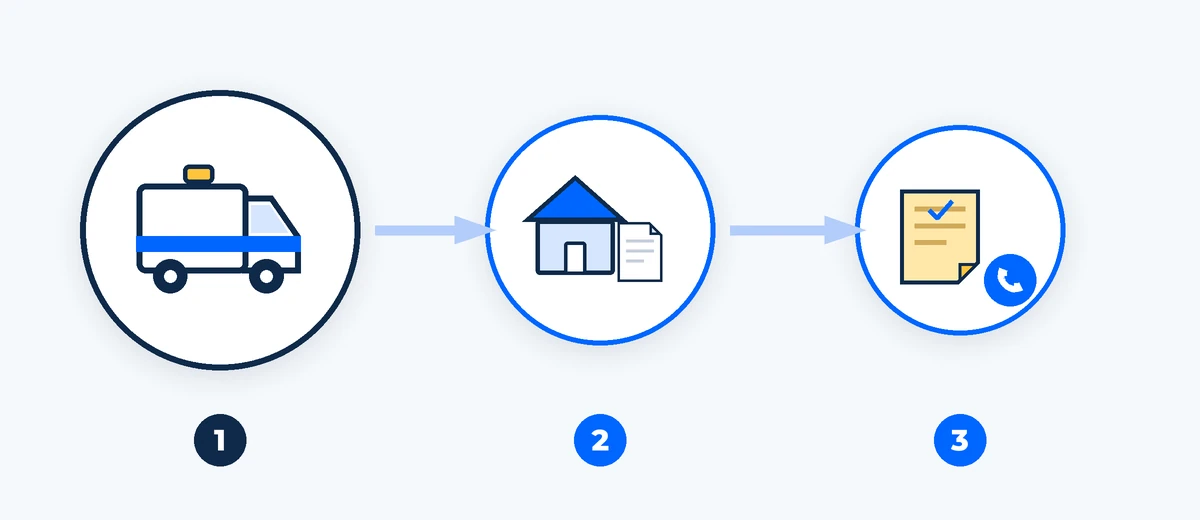
Figure 1. What to do first. ① In Korea: call 119. ② At home: see a local doctor. ③ Tell the treating institution, and note when you contacted them.
Do not wait to sort out who is responsible if you have:
In Korea: call 119 for an ambulance.
At home: see a local doctor. Tell them what was done in Korea.
Then: tell the treating institution in Korea and ask what they advise. Note when you contacted them and what they said.
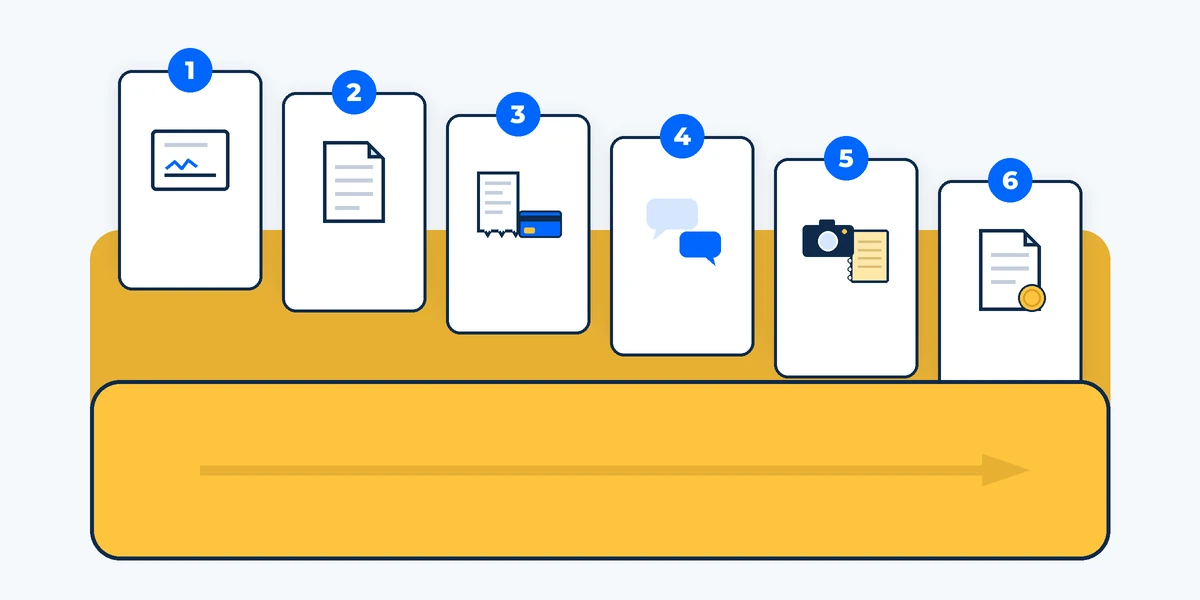
Figure 2. Six kinds of records to keep. ① Consent form. ② Medical records. ③ Payment proof. ④ Communication. ⑤ Photos and a symptom diary. ⑥ Later care records.
Good records make every complaint channel work better. Start collecting them as soon as you suspect a problem.
| Record | What it is | Where to get it |
|---|---|---|
| Consent form | The form you signed before treatment. For surgery or general anesthesia, Korean law requires written consent (Medical Service Act, Article 24-2) | Ask the institution for a copy |
| Medical records | Operation notes, prescriptions, test results and images. Patients can ask to see or copy them (Medical Service Act, Article 21) | Ask the institution |
| Payment proof | Quotes, contracts, receipts and card statements | Your email, wallet and bank app |
| Communication | Emails, chat messages and call logs with the institution or anyone who arranged your treatment | Your phone and email |
| Photos and a diary | Dated photos of the affected area and a short daily note of symptoms | Make them yourself |
| Later care | Records and bills from any doctor who treated the problem afterwards, including at home | That doctor |
(Medical Service Act, law.go.kr, as of Oct 2026)
Tips:
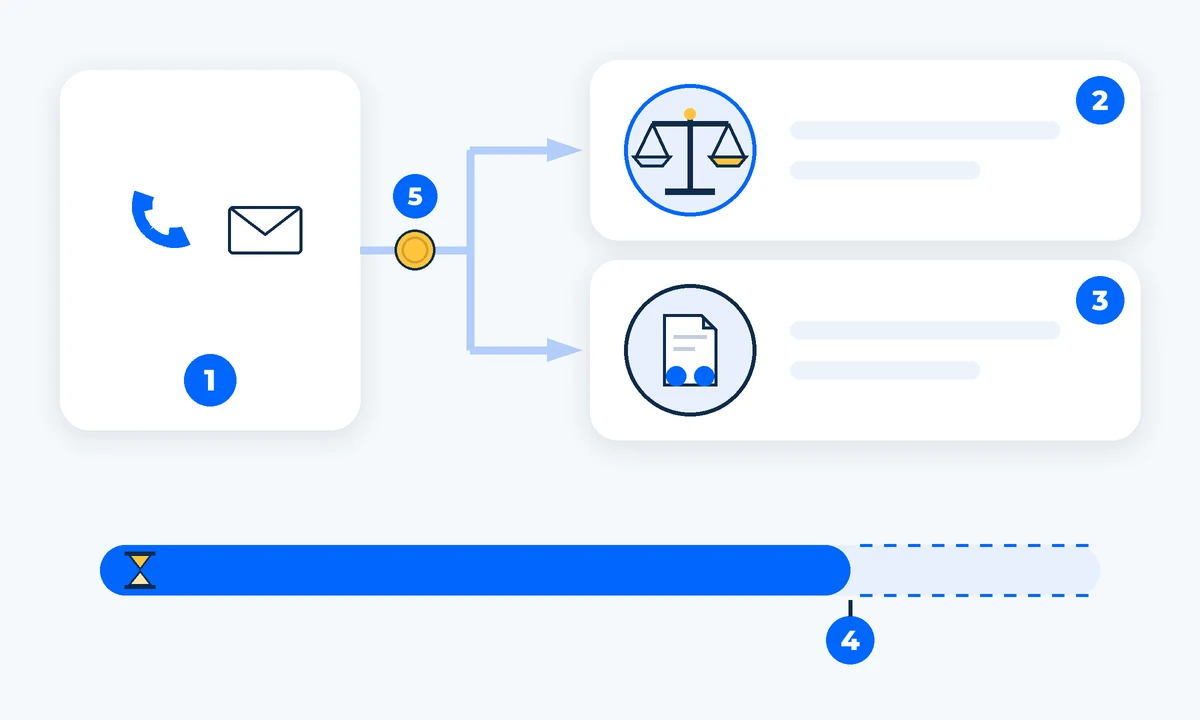
Figure 3. How K-medi works. ① Free counseling: +82-2-1670-2545 or email. ② Mediation: a panel reviews the case and proposes a settlement. ③ Arbitration: both sides agree in advance to accept the decision. ④ About 90 days, extendable to about 120 days. ⑤ Application fee from KRW 22,000.
The Korea Medical Dispute Mediation and Arbitration Agency (K-medi) is a public institution under the Ministry of Health and Welfare. It was set up under the Act on Remedies for Injuries from Medical Malpractice and Mediation of Medical Disputes. It handles disputes for both Koreans and foreigners.
You can first ask for advice about your situation. Counseling is free (K-medi, as of Oct 2026).
Since 2012, K-medi has offered three-way interpreted counseling (a phone call with you, K-medi and an interpreter) with the Ministry of Justice’s foreigner information center. It covered many languages, including English, Chinese, Japanese, Vietnamese, Russian and Thai (Ministry of Health and Welfare, 2012). The current K-medi pages do not mention this service. The 1345 line still offers three-way interpreting with public bodies (Korea Immigration Service, as of Oct 2026). Ask whether it works for K-medi before you rely on it.
If counseling does not solve the problem, you can apply for mediation.
| You live… | How to apply |
|---|---|
| In Korea | Online, by email or by fax |
| Abroad | By email or by fax |
(K-medi, as of Oct 2026)
To apply by email, send your application documents to forcc@k-medi.or.kr, as K-medi’s email application guide says. The address kmedi@k-medi.or.kr at the bottom of the website is a general contact address (K-medi, checked Oct 2026).
Application documents must be in Korean. English documents are accepted only with a Korean translation (K-medi, as of Oct 2026).
An application form for patients is available in English on the K-medi website.
K-medi aims to finish cases in about 90 days, extendable to about 120 days (K-medi, as of Oct 2026).
The application fee depends on how much money you claim (K-medi fee information, as of Oct 2026):
| Amount you claim | Fee |
|---|---|
| KRW 5 million or less | KRW 22,000 |
| Over KRW 5 million, up to 50 million | KRW 22,000 + KRW 20 for every KRW 10,000 over 5 million |
| Over KRW 50 million | The above, + KRW 10 for every KRW 10,000 over 50 million |
Examples from K-medi: a KRW 10 million claim costs KRW 32,000. A KRW 100 million claim costs KRW 162,000. Some groups, such as people with disabilities, can get a lower fee or no fee.
(Act on Remedies for Injuries from Medical Malpractice and Mediation of Medical Disputes, Article 27, law.go.kr, checked Oct 2026)
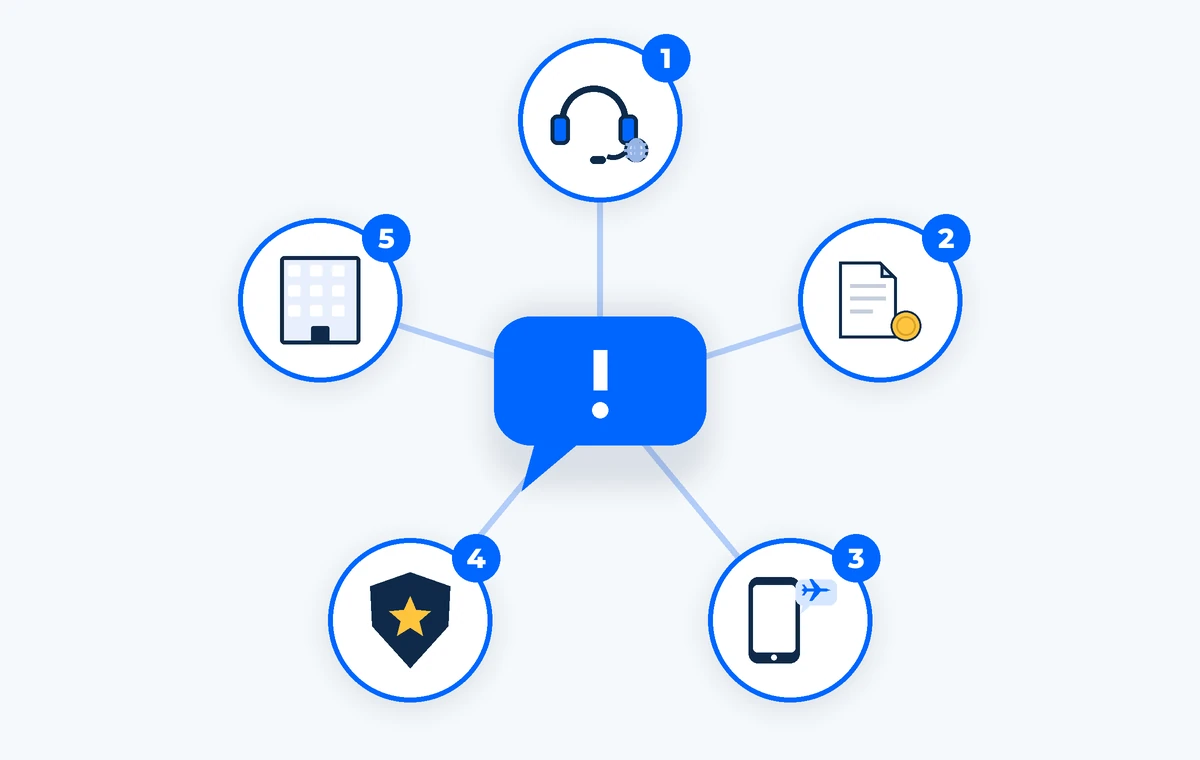
Figure 4. Other places to report. ① Medical Korea Information Center: complaints and brokers. ② 1372: refunds, deposits and contracts. ③ 1330: tourist complaints and interpretation. ④ 112: fraud, unlicensed practice and threats. ⑤ Local public health center.
| Channel | Use it for | Contact |
|---|---|---|
| Medical Korea Information Center | Information on complaints and disputes. Reports about illegal patient brokers (people who arrange patients without registration) | +82-2-1577-7129 |
| 1372 Consumer Counseling Center | Consumer issues: refunds, deposits and contract terms. The Korea Consumer Agency also handles some medical consumer cases. But if you file the same dispute there, K-medi cannot accept it | 1372 (normal call rate) |
| 1330 Korea Travel Hotline | Tourist complaints. Phone interpretation, 24 hours in Korean, English, Chinese and Japanese | 1330 (from abroad +82-2-1330) |
| Police | Suspected crimes, such as fraud, an unlicensed person doing a procedure, or threats. Police can arrange interpretation | 112 |
| Local public health center (bogeonso) | Concerns about how an institution operates. Each district has one, and it oversees local medical institutions | Your district office |
(Medical Korea, Korea Tourism Organization, Korea Consumer Agency and the Act on Remedies for Injuries from Medical Malpractice, Article 27(3), as of Oct 2026)
Choose carefully between 1372 and K-medi. If your problem is about the medical result, ask K-medi first. Filing with the Korea Consumer Agency can stop K-medi from taking the same case.
The 1372 line does not officially state foreign-language support. A public health center usually works in Korean. You can ask 1330 or 1345 to help interpret by phone.
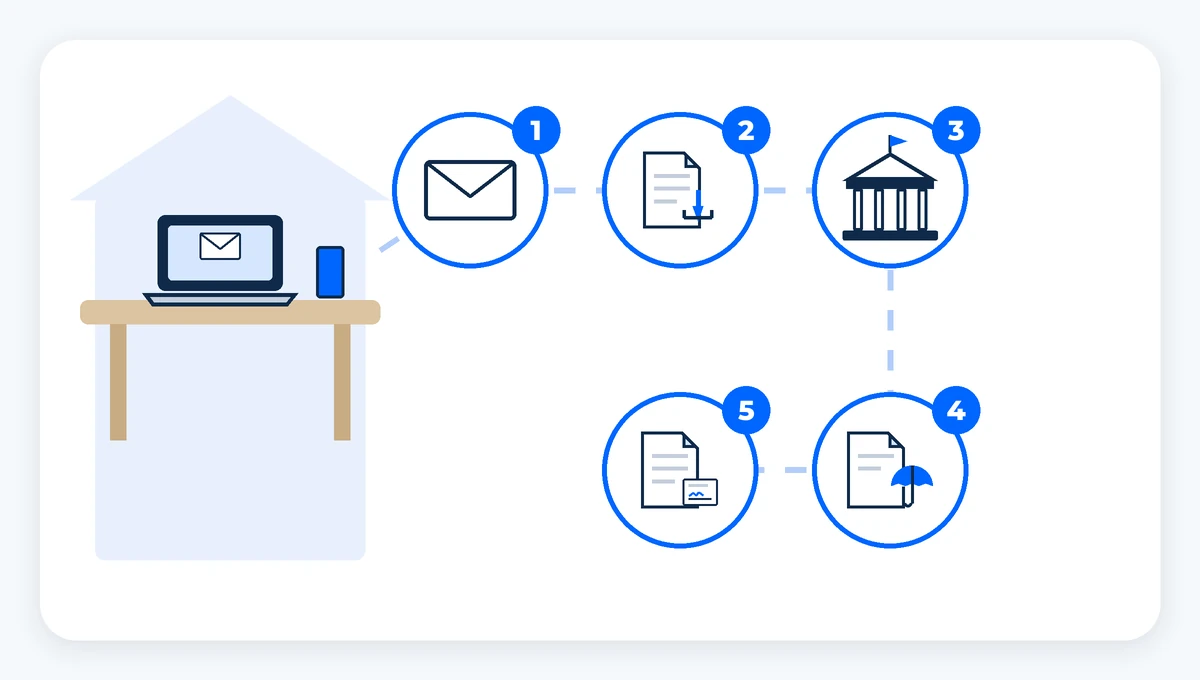
Figure 5. Five steps from home. ① Email K-medi. ② Request your records. ③ Contact your embassy or consulate. ④ Talk to your insurer. ⑤ Get a written opinion at home.
You can still act after you leave Korea.
Keep everything in one folder, in date order. It makes each step faster.
Can I use K-medi if I am not Korean? Yes. K-medi handles disputes for foreigners too. If you live abroad, you can apply by email or fax (K-medi, as of Oct 2026).
Is K-medi free? Counseling is free. Mediation has an application fee starting from KRW 22,000, based on the amount you claim (K-medi, as of Oct 2026).
How long does mediation take? K-medi aims for about 90 days, extendable to about 120 days (K-medi, as of Oct 2026).
What if the clinic refuses to take part? Mediation needs the institution to agree. If it does not agree within 14 days, the application is dismissed. Death, being unconscious for 1 month or more, and some severe disability cases start automatically (Article 27 of the medical dispute law). Otherwise, you may need legal advice.
Who do I call about a refund or deposit? The 1372 Consumer Counseling Center handles consumer issues like refunds and deposits. If the dispute is about the medical result, ask K-medi first, because filing with the Korea Consumer Agency can stop K-medi from taking the case.
Is there a deadline? Yes. Apply within 10 years of the treatment, and within 3 years of learning about the harm and who caused it.
What if I think it was fraud? Call the police on 112. Police can arrange interpretation. See also our guide on avoiding brokers and scams.
If you’d like help planning, you can talk to a coordinator.